
Spend five minutes around anyone in tech right now and the word “agent” turns up. The pitch is seductive. Instead of an AI that only answers questions, you get one that does the work — booking, researching, organising, building — with barely any hand-holding. Trouble is, the term has been stretched to cover everything from a genuinely autonomous system to a chatbot wearing a slightly nicer hat. So let’s be precise. Here is what an AI agent actually is, where it earns its keep today, and where it still walks straight into a wall.
What Separates an Agent From a Chatbot
A plain chatbot takes your message and hands back text. An agent goes further: you give it a goal, and it can take actions in the world to chase that goal, watch what happens, and decide the next move. The difference is the loop. An agent plans, acts, checks the result, adjusts — often several times — before it calls the job done.
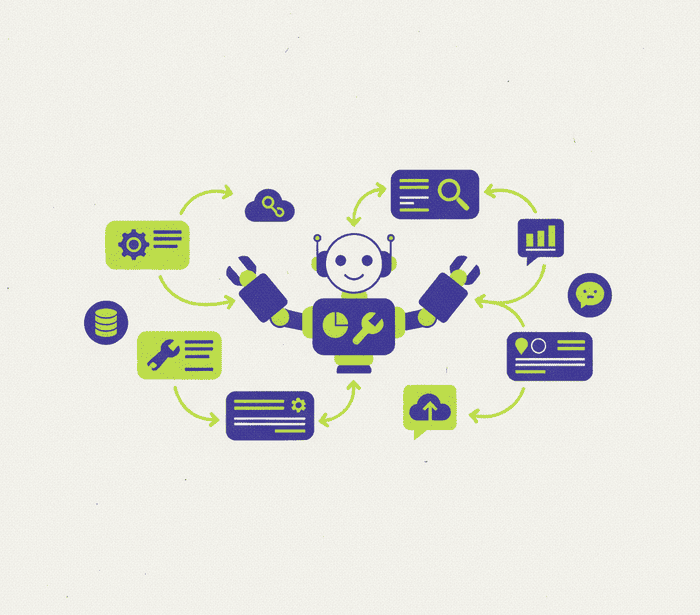
Three ingredients turn a language model into an agent. First, a goal you hand it. Second, a set of tools it is allowed to use: searching the web, running code, querying a database, calling some other piece of software. Third, the loop that lets it use those tools over and over and react to what they return. Take away the tools and the loop, and you are back to a chatbot that can talk about a task but never actually do it.
Tools Are the Whole Point
Left to itself, a language model can only generate text. Tools are how it reaches out and touches the real world. Need current information? It calls a search tool. Need arithmetic it can trust? It runs code instead of guessing. Need to send an email or update a calendar? It calls the right service. The model picks the tool, decides what to pass it, reads the result, and carries on. The range and quality of an agent’s tools largely decide how useful the whole thing can be. Weak tools, weak agent — no exceptions.
Where Agents Genuinely Pull Their Weight
Agents shine on tasks that are well-defined, repetitive, and easy to check. Picture work where the goal is clear, the steps are bounded, and a mistake is cheap to catch or undo. Drafting and refactoring chunks of code. Pulling information off dozens of pages and compiling it into a summary. Filling in structured forms. Sorting and tagging large batches of items. Marching through a fixed multi-step procedure. These are the places an agent saves you real time.
The common thread is feedback. When an agent can run a test, read the error, and try again, it makes steady progress because reality keeps correcting it. Tasks with that built-in check suit agents well. So do tasks where a small slip costs almost nothing, because the occasional misstep does no lasting damage.
Where They Still Fall Apart
The limits matter just as much, maybe more. Agents struggle with long, open-ended goals that demand sustained judgement. The further a task drifts from a clean definition, the more an agent wanders, misreads the situation, or strides confidently off in the wrong direction. And early errors compound. A flawed assumption in step two quietly poisons steps three through ten, and the agent never notices it went astray.
Agents also inherit every weakness of the language model inside them. They can be confidently wrong — inventing details, misjudging whether a step even worked. Because they act rather than just chat, those mistakes carry consequences: editing the wrong file, taking some action that is a pain to reverse. They have no real common sense and no reliable read on their own uncertainty, so they rarely stop to ask for help at the exact moment a person would.
The Reliability Math Nobody Mentions in the Demo
A single step might succeed 95 times out of 100. Sounds great. Now chain twenty of those steps in a row and the odds of getting clean through all of them collapse, because each step’s small failure rate stacks on the last. That compounding is the quiet reason agents look dazzling in a thirty-second demo and maddening on a long, messy, real-world job. No single piece is broken. It is that staying reliable across many dependent steps is genuinely, stubbornly hard.
Working With Agents Without Getting Burned
You can get plenty out of agents today if you set them up with some care. A handful of principles carry most of the weight. Keep a human in the loop for anything consequential — the agent proposes, a person approves, before any irreversible action fires. Scope tasks narrowly, with a clear definition of done, instead of dumping a sprawling open-ended mission on it. Give it the least access it needs, so a mistake simply cannot reach beyond its lane.
It also pays to favour reversible actions and to actually watch what the agent is doing rather than treat it as a black box. Following its steps lets you catch a wrong turn early, before it snowballs. Think of an agent less like an employee you can fully delegate to and more like a fast, capable, slightly green helper who needs clear instructions and a second pair of eyes.
The Honest State of the Technology
AI agents are real and improving fast. This is not pure marketing. The shift from systems that talk to systems that act is genuine, and it opens up a whole class of useful, time-saving automation. But the technology is uneven. Strong on bounded, checkable, low-stakes work. Weak on long, ambiguous, high-stakes work. The reliability gap across many steps is the central, unsolved problem, and pretending otherwise sets you up for disappointment.
So Where Does That Leave You
Treat AI agents as powerful assistants for well-scoped, low-risk work, and as something to supervise closely everywhere else. Start small, with clear success criteria and reversible steps. Give the agent only the access it actually needs. Keep a person in the approval loop for anything that matters. Stay inside those limits and agents quietly absorb a surprising amount of repetitive work. Push past them and they will let you down at the worst possible moment. Match the task to what the technology genuinely does well, and you get the upside without the nasty surprises.